COFFEE WITH
IN CONVERSATION WITH VIC BROOKS, JENNIFER BURRIS & MARIANA FERNÁNDEZ ON “TUNING CALDER’S CLOUDS”
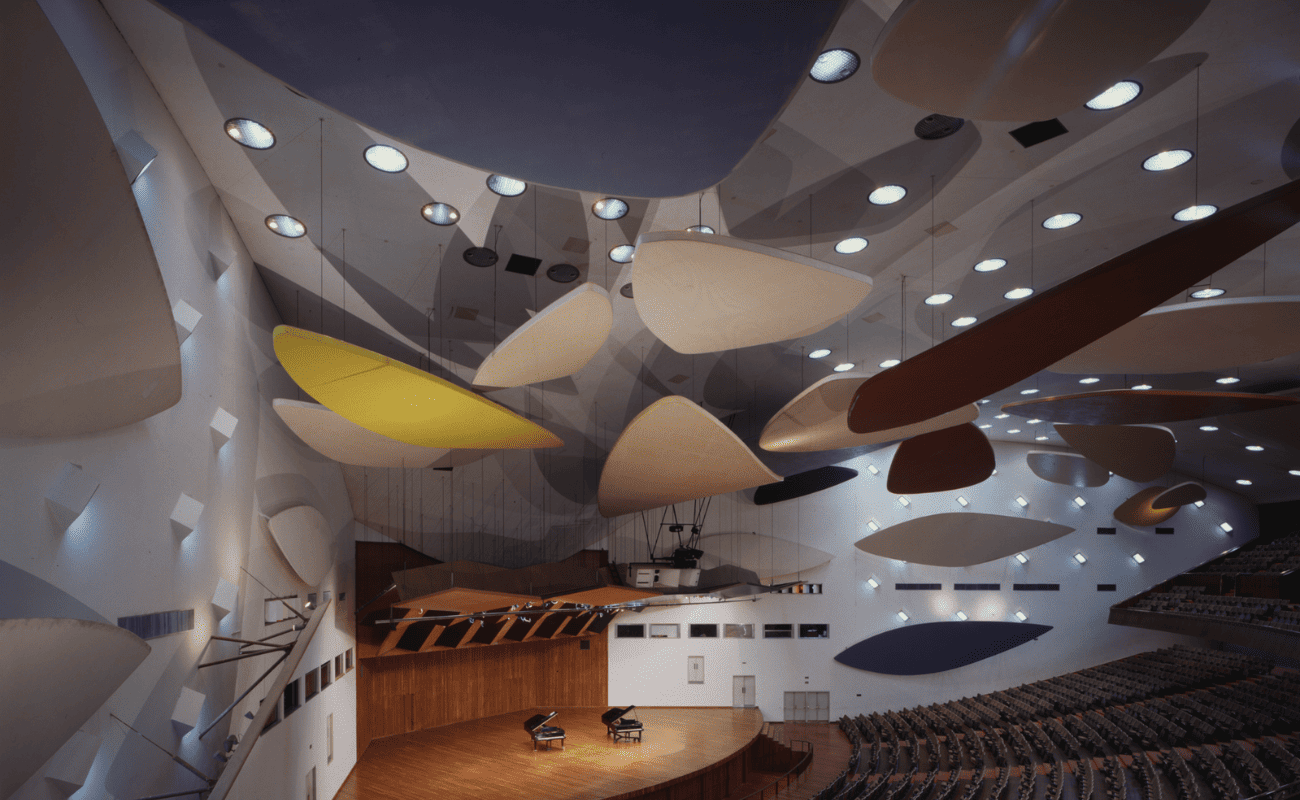
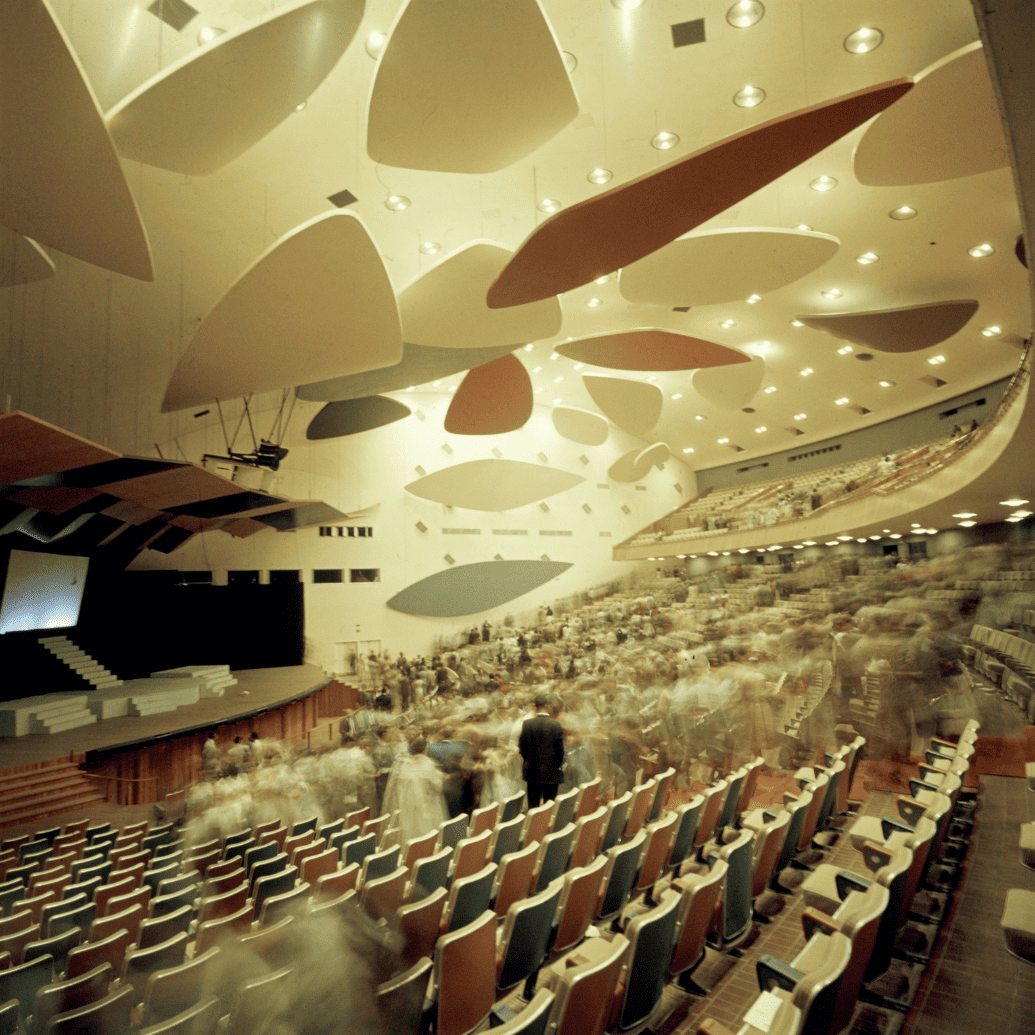
Alexander Calder’s monumental Acoustic Ceiling (1954) in the Aula Magna of the Universidad Central de Venezuela in Caracas has long been celebrated as one of the most remarkable intersections between art, architecture, and sound in Latin America. Yet, beyond its floating colorful panels and its iconic presence within Venezuelan cultural history, the story behind its creation reveals a much deeper narrative of collaboration, experimentation, and artistic exchange.
More than six decades after Calder and architect Carlos Raúl Villanueva transformed a university auditorium into a groundbreaking total work of art, the new book “Tuning Calder’s Clouds” revisits the legacy of this extraordinary project. Through previously unpublished letters, photographs, and conversations with artists, architects, scholars, and musicians, the book explores how a visionary collaboration in 1950s Caracas reshaped Calder’s practice and continues to influence generations across Latin America and beyond.
We sat down with editors Vic Brooks, Jennifer Burris, and Mariana Fernández to discuss the making of the book, Calder’s relationship with Venezuela, and the legacy of an artwork where movement, sound, and architecture exist in perfect harmony.
LATINNESS: How long have you been working on the book?
JENNIFER: Since 2018 when Vic and I first went to Caracas to begin the research. It was just a year before the pandemic.
After that trip, we started thinking about expanding the project into a book rather than focusing solely on the commission we had originally been planning with Venezuelan-Ecuadorian artist Ana Navas. A few months after we decided to make it a larger publication, the pandemic hit, everything shut down, and we were no longer able to travel. So the entire project was delayed for several years.
LATINNESS: Alexander Calder is known around the world, but his connection to Venezuela is less familiar. How did that relationship begin?
JENNIFER: The primary reason Calder became so involved with Venezuela was because of his friendship with the architect Carlos Raúl Villanueva. They were introduced by a mutual friend in the early 1950s.
At the time, Villanueva was in the early stages of creating this University in the center of Caracas, and his idea was to fully integrate artists into the architecture and design from the offset. He called it the “total synthesis of the arts.”
Earlier he had been designing his buildings and then commissioning art at the end. And so the idea of this was to bring in artists to be part of the planning and design process.
He was introduced to Calder, and they just remarkably hit it off. Together, they created the acoustic ceiling installation in the Aula Magna auditorium at the core of the university campus.
Villanueva would introduce Calder to architects, designers, and other artists throughout Venezuela. That is how Calder became increasingly involved with the country and its creative community.
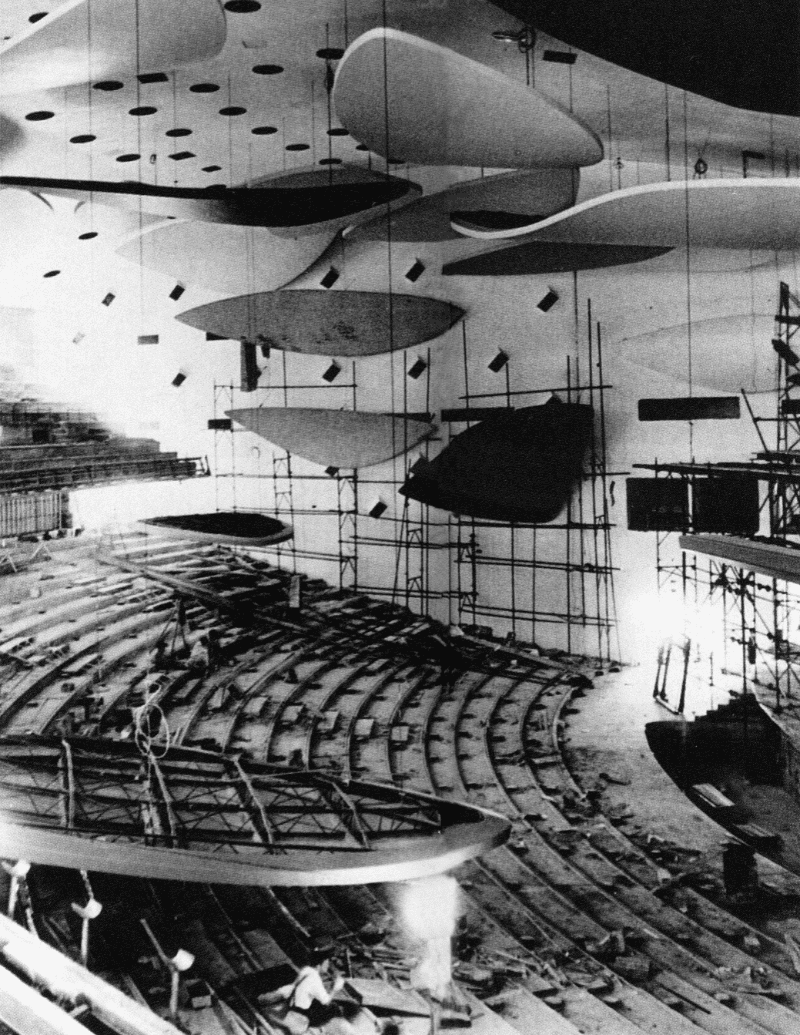
LATINNESS: In your research, you uncovered so many fascinating things. Can you paint a picture of what Venezuela was like during that period? It was such a unique moment in the country’s history, and one that remains relatively unknown to many people.
MARIANA: We have a wonderful essay in the book by Rafael Santana, the former director of the Galeria de Arte Nacional in Caracas,, which really provides the historical grounding. It talks about this very unique period in Venezuela in the 1950s, when the country was trying to find its own vision of modernism and establish a national identity on the global stage.
That text is really important to understand the art historical changes happening in Venezuela at the time. There were many collectives and manifestos, and artists were moving away from traditional painting to create larger installations and more immersive works.
It was also a period closely connected to state-funded programs and major housing projects that Villanueva developed.
One thing that was important for us in the book was not to tell only one history, but to show how these different stories connect. The book is a little bit like the acoustic ceiling itself — a series of reflectors pointing toward different forms of connectivity.
VIC: There was also a very specific political context. Venezuela was under the control of the military dictatorship of Marcos Pérez Jiménez. While the dictatorship suppressed democratic debate, it was incredibly focused on supporting large-scale building projects, developing the city, and embracing architectural modernism.
So there is this tension between a very radical artistic vision, which was fully supported by the government, and the lack of democratic pluralism on the political level.
What that meant was that these large-scale projects could happen very quickly because the government was pushing them forward. This also coincided with the economic boom from oil. During the 1950s and 60s, Caracas transformed dramatically: hospitals were built, public housing, university structures, roads, canals, and bridges.
What is interesting is that even artists and writers who were very critical of aspects of the regime still look back at this period with a certain nostalgia because of what was achieved culturally and architecturally.
There is a wonderful book by art historian Lisa Blackmore, Spectacular Modernity: Dictatorship, Space, and Visuality in Venezuela, 1948-1958, which explores this particular vision of Venezuela during that period.
LATINNESS: You mentioned the political context of Venezuela during that period. Given that we often associate dictatorships with the suppression of artistic movements, what was the relationship between the Pérez Jiménez regime and modernism? Why did the government support these artistic and architectural projects despite its political restrictions?
JENNIFER: What has come across to me is that it was really about fashioning this idea of modernity. They wanted to show that Venezuela was a modern nation, and one of the most obvious ways of communicating that was through the image of modernism: modernist artists, modernist buildings, and modernist aesthetics in general.
This is not how we typically understand modernism — as something that could exist alongside a lack of democracy — because there was this tension happening that is different from the narratives we are often taught.
VIC: I think there is also something very specific about the Aula Magna in this context. The reason it was designed and constructed so quickly was that it had to be completed for the 10th Inter-American Conference in 1954.
That conference was, in many ways, an anti-communist conference, where the United States and other countries were building relationships with these oil-rich, right-wing governments. So that is a key point: the Aula Magna and that entire period really embody that impulse of projecting Venezuela as a modern nation on the international stage.
LATINNESS: How many works by Calder have you identified in Venezuela?
JENNIFER: That’s a difficult question because the number has changed over time. At the height of this period, in the mid-1960s, we know there were at least 65 works in Venezuela.
They ranged from commissions for private homes and commercial buildings to major public works like the Aula Magna. There are also three permanently-installed sculptures at the architecture faculty of the Central University.
It’s difficult to fully trace them today because many of these works have been sold as people have left the country, while others that remain in Venezuela are not always publicly documented. But there are still very iconic Calder works located at important sites connected to national identity.
Of course, the Acoustic Ceiling in the Aula Magna remains — a permanent, site-specific installation. There are also works in places like the Gio Ponti’s Villa Planchart, which has been beautifully conserved, and in the central courtyard of the Museo de Bellas Artes in Caracas. Other works are now in collections such as MoMA and SFMoMA, or have left the country through private sales and auctions.
So the number is somewhat fluid, but at one point there were at least 65 works across Venezuela, which is a remarkable number.
MARIANA: It’s also interesting to think about the role that Calder embodied in Latin America more broadly. For example, in Mexico in the late 1960s, he played a similar role with a major commission he created in 1967, ahead of the Olympic Games.
It was a huge, towering sculpture outside the soccer stadium, created as a way for Mexico to present its economic progress and modern identity on the world stage.
So there is this recurring idea of bringing in these quintessential modernist artists to embody progress and modernity, even while there were complex political circumstances happening beneath the surface.
LATINNESS: Art critic Phyllis Tuchman has suggested that Calder’s work is, in many ways, deeply connected to Latin America. In your research, did you find moments where Calder had to navigate or better understand Latin American cultural codes and nuances when creating his works?
JENNIFER: So interestingly enough, more than a decade before Calder started working with Villanueva, he contributed a light-reflecting mobile to a hotel in Venezuela in 1941.This was a hotel designed by an architect called Walter K. Harrison, who was the official architect of Nelson Rockefeller. At that point, Nelson Rockefeller had developed an agency that was really seeking to economically invest in the country, and he wanted to build a hotel geared to that effect.
Because Harrison had worked with Calder often in the past, he asked Calder to create a large-scale mobile for the ballroom area of the hotel.
Calder created this beautiful work from unpainted aluminum. The idea was that it was made of raw metal that would refract light and really engage with the equatorial shadows and tonality of Caracas.
But it absolutely did not work as intended. The anecdote that Calder himself talked about was that it was “making patrons drunk”, referring perhaps to how people would look up at it during a night out and become overwhelmed by the movement.
So the architects brought it back to the United States and installed it at the official headquarters of the Aluminum Company of America in Pittsburgh, which was a radically different venue and atmosphere both architecturally and also in terms of the intended use (work as opposed to leisure) and surrounding climate and geography.
It’s interesting that, following this first experience, it was over ten years before Calder reengaged with Venezuela. After this initial encounter, all of his future works in the country were in direct collaboration with Venezuelan artists, architects, or designers.
It seemed like he understood that, in order for his work to be properly situated in the country, it needed to be in dialogue with someone who understood the nuances of that social and cultural context. So I think that initial failure led to a profound corrective period that shaped the relationships and collaborations that followed.
VIC: It’s worth also noting that he did have a kind of sensitivity to site. So, in terms of this kind of site sensitivity, to add to what Jen said but also go in a slightly different direction: in the Aula, for example, of course he produced the sculpture that was acting as these acoustic panels, but he was also in charge of the interior design of the entire interior.
What that meant was that he actually chose the material of the floor, and he chose that the building itself — the interior — should be white. There’s a really particular relationship he had with that. He hadn’t spent time in Venezuela by then, but he had spent extensive time in Brazil and other countries in the region.
So for him, choosing these white walls and this terracotta tiled floor was about creating an atmosphere connected to the domestic homes and experiences of the region. He was very thoughtful in thinking about how he could produce something that was incredibly modern, both in terms of its form and its function.
It was the first time acoustic panels had been used to correct the acoustics of a concert hall over the audience rather than just over the stage. At the same time, he was bringing in this kind of vernacular sensibility — a sort of what he called “handmadeness.”
He made reference to that because he decided he wanted the seats to alternate between blue and a kind of orange terracotta, with different colored armrests. He wanted it to look, “handmade.” He was trying to create environments where an audience could come in and feel a sense of connection — not only through this huge, enveloping sculpture, but also through this delicate sensibility that made you feel a little bit more at home at the same time.
LATINNESS: What specific aspects of Calder’s work in Venezuela are highlighted in this book? And how do you believe these artistic, architectural and social intersections have influenced Venezuelan culture?
MARIANA: Broadly, the book is structured into historical essays — very scholarly essays that delve into subjects that have lacked historical attention — and oral histories, which speak to people’s personal relationships with the work.
That is a really wonderful way to talk about how the space holds sonic memories for performers, for students, and for people who have been influenced by this work, which holds such an important place in the cultural imagination.
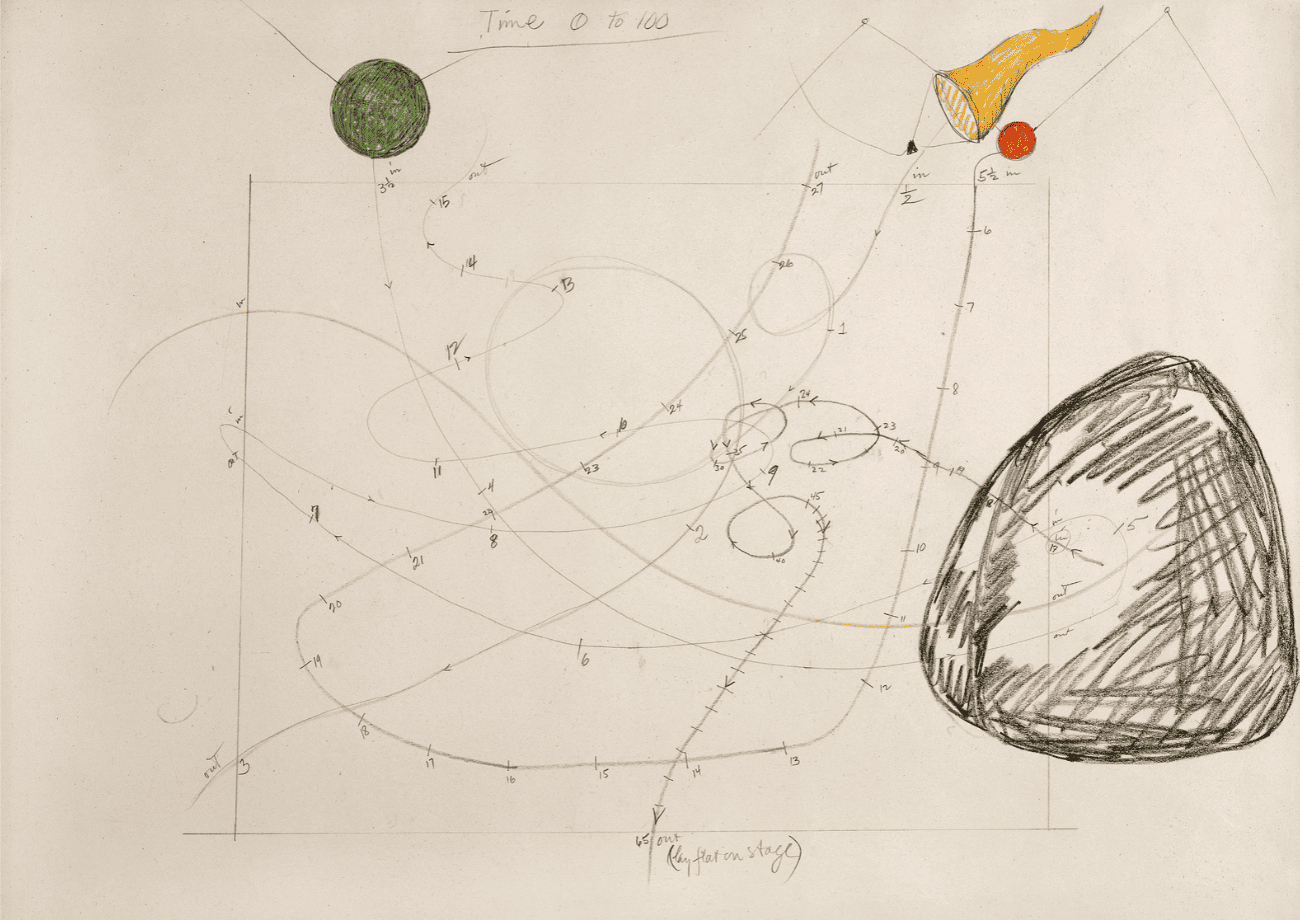
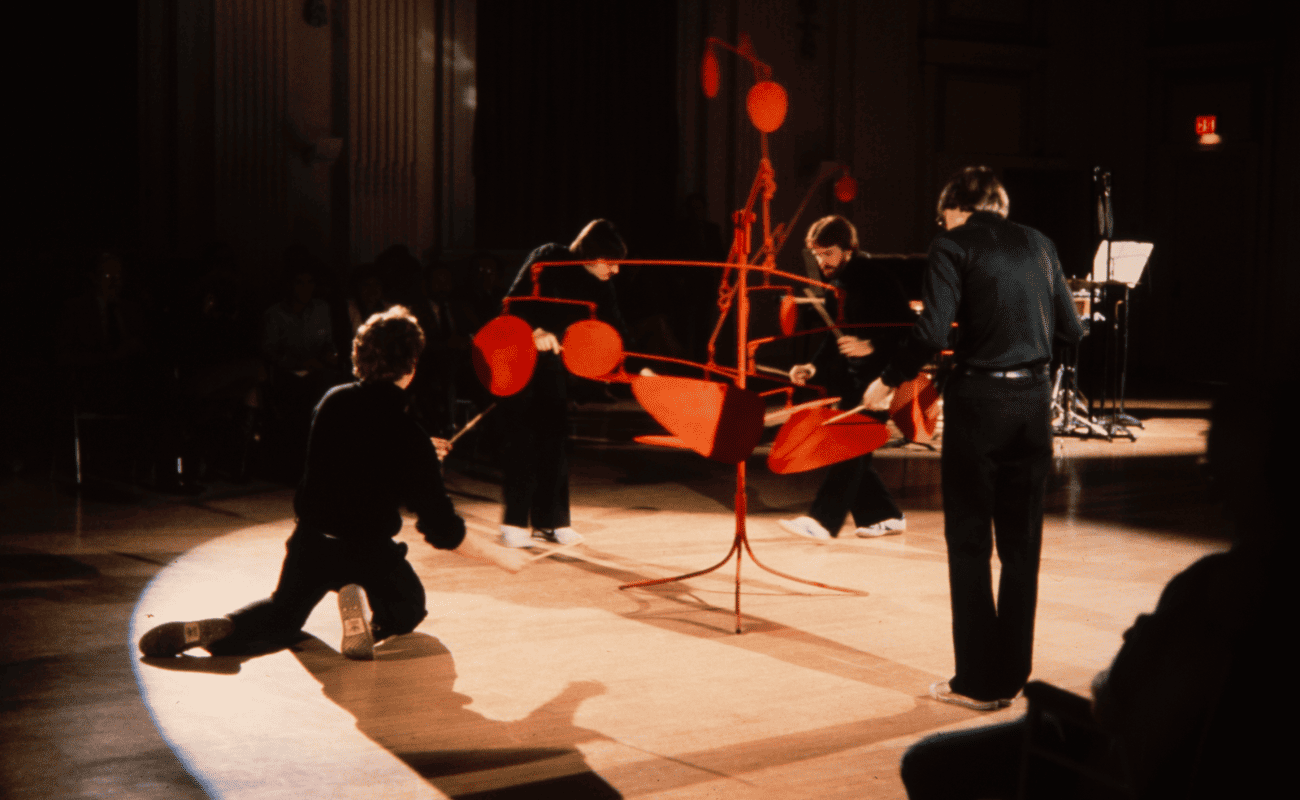
There is also a central chronology section that looks at the making of Acoustic Ceiling through letters and drawings, which beautifully illustrates Vic’s point about how collaborative the process was — how Calder and Villanueva exchanged samples and were in conversation about the colors and all these different elements.
And lastly, there is a final section that we’re calling “Resonances,” which explores the multiple afterlives of the work, both in contemporary art and in concert hall acoustics.
In the essay section, Rafael Santana’s essay, which I mentioned previously, really provides the historical grounding of the book and talks about this particular history. This text pairs with a contribution in the “Resonances” section by architectural historian María Fernanda Jaua, who was part of the team of scholars tasked with presenting the university as a whole, in particular Villanueva’s collaborations with artists, to the UNESCO World Heritage Committee, which ultimately led to the work being designated a UNESCO World Heritage Site. It is only the second architectural work from Venezuela to be included on the list.
That is a wonderful way to get a first-person perspective on how the work essentially became canonized within this history.
VIC: There’s also just something to add to that, too. Mariana pointed towards them, but I think that we’ve really centered contemporary artists in the book as well, both in terms of Ana Navas and Mirtu Escalona-Mijares, who is a Venezuelan composer based in Paris and someone Ana collaborated with. Both of them are Venezuelan, neither of them live there anymore, and they have a very particular relationship with this building, particularly with the Aula.
We were very intentional about foregrounding all these voices of musicians and artists who have worked in the hall and have an emotional relationship with it through their work and through the act of performance itself.
And that’s the interesting thing with permanent artworks: they take on their own lives. We can experience the hall in many ways as it was when it was first built, but we also bring our own experiences to it. For the people at the university, and for those who have connections with that university over time, that relationship builds and builds and becomes sedimented. It creates its own objectness, its own relationships.
And one of the most beautiful things Rafael Santana said, which was echoed by other people when Jen and I were visiting Caracas, was this idea that the Aula Magna was “the shrine of the city” or “the heart of the city” for a certain group of people who had this relationship with the university. That’s one of the reasons we wanted to bring these oral histories into the book.
MARIANA: And I think you can really see that in the multiple nicknames that the work has taken on. Venezuelans call the work Platillos Voladores (“flying saucers”), Nubes (“clouds”). So it really speaks to the emotional connection that different people have with the work, as well as the differences in how different generations refer to it.
LATINNESS: Given that they were part of the same era, we were wondering: did Op Art and Calder’s work ever intersect in Venezuela?
JENNIFER: Absolutely. They intersected hugely. And I think this is really a moment of connection in art history that needs to be further explored.
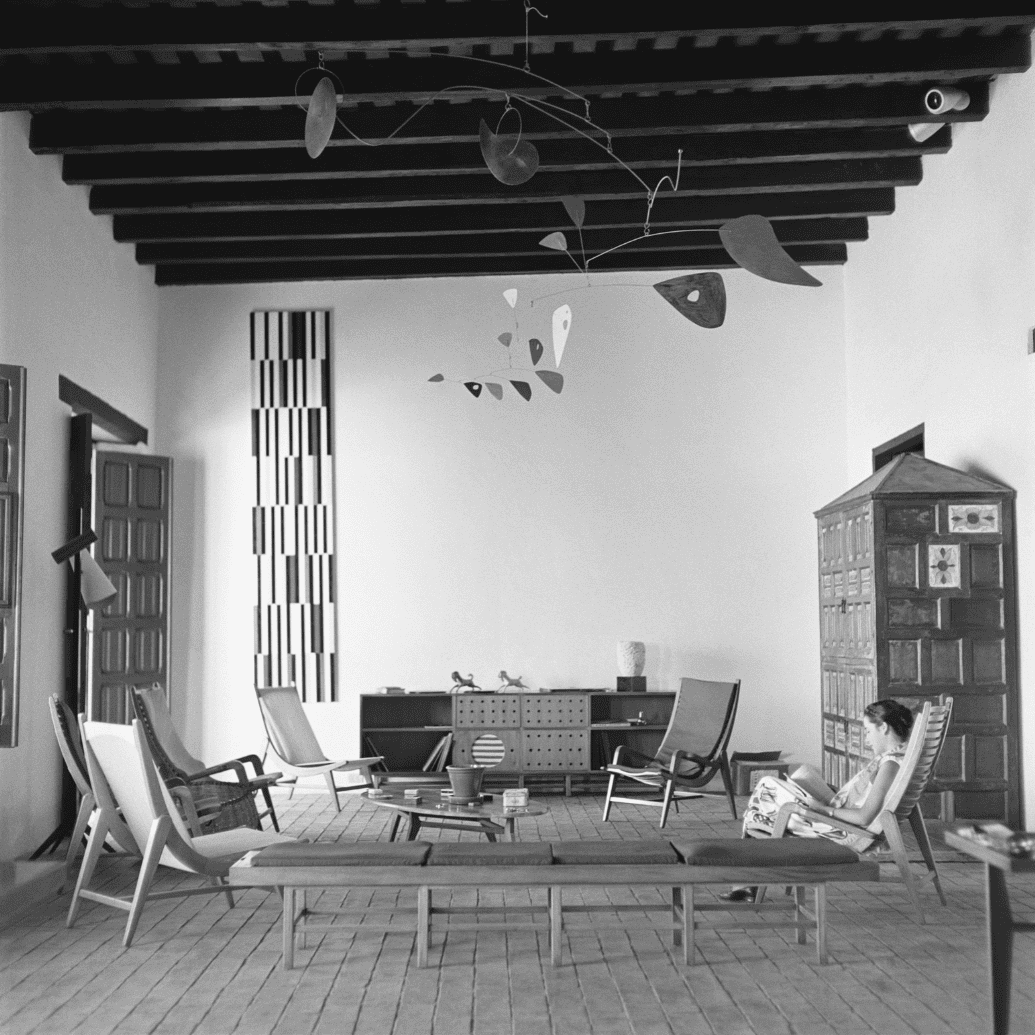
The closest connection that I know of that Calder had with one of those really iconic kinetic artists and geometric abstractionists – of which Op Art can perhaps be understood as a “bridge between” – was with Venezuelan artist Alejandro Otero. At that time, Otero was working on a lot of bespoke commissions for private homes. Venezuelan families, philanthropists, and art collectors who were interested in embracing this new moment of modernism in their country were commissioning houses that frequently involved the collaboration of Villanueva as an architect, Otero as someone who would create site-specific artworks within the house, and a furniture designer called Miguel Arroyo, who later became the director of the Museo de Bellas Artes.
Calder was brought in by Otero and Arroyo to this network of collaborators who were in frequent dialogue. You also see the kinetic artists’ interest in rhythm and color as something that creates a sensorial rhythmic energy that resonates with Calder’s mobiles.
But speaking more formally,, and in particular if we trace work in kinetic art or Op Art back through experiments in geometric abstraction, we can find further connections between Calder and this generation of Venezuelan modernists in their shared references of Mondrian, who is someone that Rafael Soto, for example, discusses as a core influence. Calder also visited Mondrian’s studio in the 1930s, where he remembers seeing squares of color taped up on the studio walls. In later interviews, he recalled wondering, which I am paraphrasing here, “Wouldn’t it be beautiful if these squares, these forms, these images could begin to move?”
That impulse to set abstract color into motion was something that Soto remembers feeling 20 years later: two very similar impulses in response to the work of Mondrian, which happened independently of one another Otero went to Holland specifically to study Mondrian’s work, and he brought back the knowledge and inspiration he gained through such study to Venezuela. If we are trying to map this network of intersections art historically, I would say that Calder’s early fascination with color and movement (fascinations that were later, and independently, arrived at by Soto and other Venezuelan artists) were ultimately brought into dialogue or connection with one another as a result of Villaneuva’s invitation to Calder to create a work in Caracas. The creation of this work brought together, in real time and space, these independently evolving currents in artistic practice that ultimately can be understood as somehow in resonance. So you have this real collective genesis of shared desire or intuited pathways in the making of art across geographies and contexts.
LATINNESS: You mentioned to us earlier that one of the conversations in the book is between Sandy, Calder’s granddaughter, and Villanueva’s daughter, about their family relationship. Without revealing too much about the book, I’m fascinated to know what you found in that conversation and what that relationship was like.
MARIANA: That was a really interesting text to develop. Sandy and Paulina met for the first time at the Calder Foundation and they looked at photographs of Sandy’s grandfather and Paulina’s father vacationing in Venezuela and in France, as well as letters and all of these super personal materials.
The conversation that was published was developed from that meeting and through emails and exchanges afterward. It does such a unique job of both situating Calder in Venezuela through the crucial role that Villanueva played as curator, dealer, and friend, but also through the personal relationship of the two families.
Their family lives were intertwined. I mean, Calder made a portrait that is in Paulina’s family home’s bathroom, and she says, “We can never paint the bathroom because there’s this portrait there.” So there are all these little anecdotes about how close she was to Luisa, Calder’s wife.
And that, I think, really gets at the personal dimensions of their relationship and makes clear why their professional collaboration was so fruitful.
LATINNESS: How beautiful. Do you have any anecdotes of seeing these works in real life?
JENNIFER: When Villanueva first proposed the project of the Central University campus to Calder and explained how massive it would be and how many artists would be involved, apparently Calder’s response was, “If you achieve this, you must be the devil.” And he did achieve it.
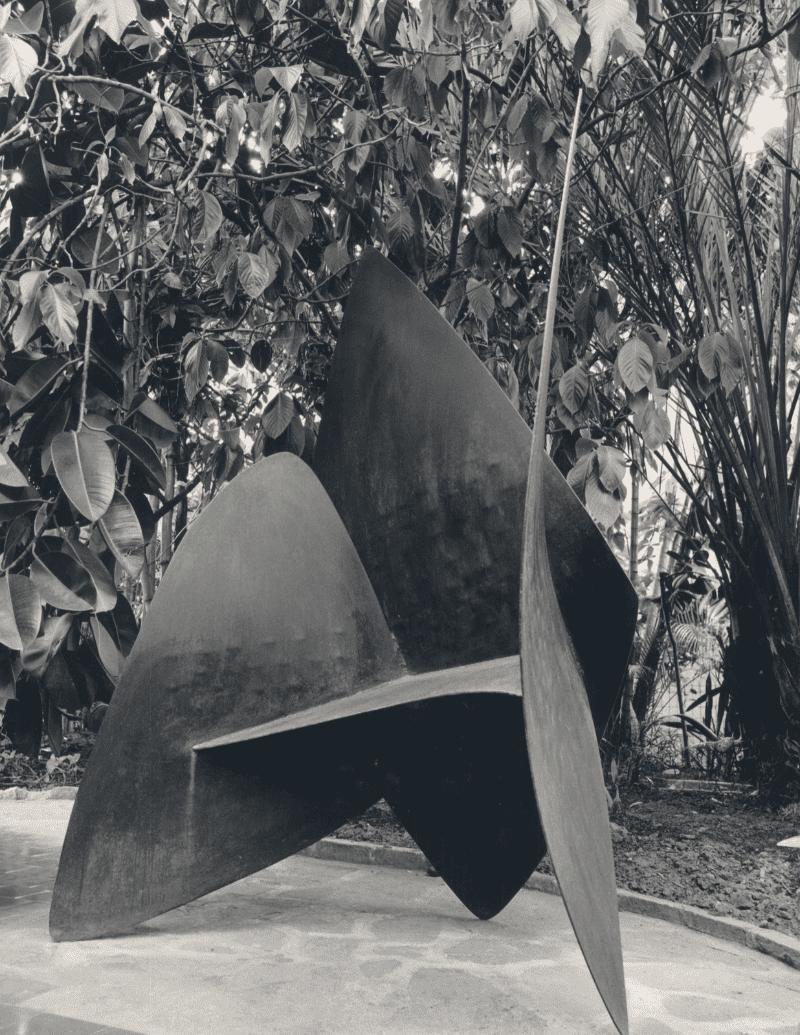
So when Calder spent a month in Caracas, working in the blacksmith workshops he created this kind of anthropomorphic sculpture that he called the Devil’s Chair, which he gifted to Villanueva and which is still in their collection.
MARIANA: And Villanueva gifted Calder this sculpture called Ensamblaje, which was kind of an homage to Calder’s mobiles. It’s like a globe that hangs on a little tripod. So it’s a beautiful little exchange of gifts.
JENNIFER: One of the experiences that struck me the most when we first visited the Acoustic Ceiling at the Aula Magna was that they brought us up on top of the panels themselves. You can go up to the ceiling and descend by stairs and suspenders, and stand on top of the panels. You have this entirely different view of the auditorium and can experience these objects up close — see the details of their construction, how they were made, and how the light is deployed. That completely blew me away.
VIC: It was kind of an extraordinary experience, actually. Again, Rafael Santana and Juan Pérez Hernández, who at the time was in charge of the archiving and conservation side at the university, really allowed us a backstage view, quite literally. We went up above the ceiling, over the top of the panels, and you could really see how the infrastructure of the whole work functions.
And, you know, it’s a concert hall, not a museum. So of course you have a very detailed lighting system that Calder also had a hand in. There were three different types of light: side lighting and spotlights, and they still have the original spotlight, which was an arc light. They used a carbon rod and you literally set fire to it. It’s an incredibly powerful light, and it’s still there.
And, of course, because it’s not only about conservation, it’s also because the resources haven’t always been there, nothing has really been redone or updated in that way. So you can see exactly how, in the 1950s, all the infrastructure — the wiring, the air conditioning, the lighting — was installed.
It’s slightly terrifying because you see a light board and it still has the tag from the 1950s, and you’re like, “Oh, there’s a fire just waiting to happen.” In fact, there was a fire some years ago, but luckily it didn’t do much damage.
One of the things that struck me — and one of the reasons I wanted to do the book — was that I had been researching the Aula Magna for many years through my work with the Calder Foundation, and I was trying to grapple with the fact that this was not a well-known work, either within Calder’s own oeuvre or within the history of art and architecture.
Of course, Villanueva was really well known for the University, but Calder was less so. And what struck me was actually how the infrastructure of that particular concert hall was not so different from how they build concert halls today.
At the Experimental Media and Performing Arts Center, where I was working, we built a concert hall that opened in 2008, about 50 years later, and it also had a very particular ceiling. It was actually the first cloth ceiling in the world, which allowed the low frequencies to go straight through and travel another 20 feet above, while the middle and lower frequencies — the frequencies of the human voice — were bounced back down, so you could understand each other.
And when you think about these two concert halls, half a century apart, and all the technological advancements that happened in architecture, acoustics, and art during that time, it’s remarkable how similar they actually were.
The Aula Magna was truly groundbreaking. There’s no other way to put it: it changed how acousticians and architects approached concert hall acoustics and the ways in which they could shape sound for audiences.
The challenge with a fan-shaped hall like the Aula Magna is that the curved back wall and ceiling tend to focus sound into the center of the room. What you want instead is to create an acoustic where sound waves bounce around evenly and reach every corner of the hall.
The acoustic panels that cover 70% of the ceiling — with their convex and flat surfaces — create a series of surfaces that distribute the sound evenly throughout the space.
And then, 50 years later, at EMPAC, they built a fabric ceiling for the first time, which plays with frequencies differently but is still within that same lineage.
We actually looked into this and never found a definitive confirmation, but it’s an interesting coincidence that the colloquial term “clouds” is also an acoustical term, specifically referring to these panels that hang above the audience. The term appears to have come after the Aula Magna, although we can’t say definitively that it came from that particular hall. But certainly, that was one of the first times this type of solution was created.
Those are the kinds of influences that I think go far beyond anything that scholarship has touched on so far.
LATINNESS: Did you find anything surprising in your research while you were creating this book?
VIC: I mean, there was one thing that’s completely off to the side, but when we were actually at the hall itself, we discovered that the lighting system was all brought together through something quite extraordinary. Rather than having a lighting board that you could program the lights with, as you would have today, the lighting console was actually an organ.
It was a light organ designed by Strand Lighting, which was a British company at the time. People who are really interested in light organs from this period didn’t even realize that it still existed.
I have these pictures of Jen playing the light organ from the room above the stage, because obviously you needed to be able to watch what was happening on stage while programming the system.
It was this completely revolutionary technology that operated in real time to connect the music happening in the hall with the way you could play the light, almost like an instrument.
LATINNESS: It’s a real gift to generations of Venezuelans.
JENNIFER: Something like this was only possible because of Villanueva’s capacity to manage political relationships while, at the same time, really trust the work and the vision of artists. These types of projects almost never happen otherwise.
MARIANA: I was shocked that such a site-specific work was developed entirely remotely through letters. Calder didn’t see the work until it was finished.
I don’t know if you know the story, but he was originally invited to create a work for the lobby. He told Villanueva, “I want to be inside the hall,” and Villanueva responded, “No, the hall is going to be covered by these acoustical panels that we’re developing with a firm in Massachusetts.”
Calder’s response was, “I can work with them to turn this into a sculpture.”
So the work was developed entirely through letters between Calder, Bolt, Beranek and Newman — the acoustical engineering firm in Cambridge — and Villanueva. They exchanged fabric swatches, color palettes, and drawings back and forth.
LATINNESS: Vic, you mentioned that there was so little known about this work internationally. Why do you think that is?
VIC: I’m not sure I know how to answer that question. I mean, of course, the work is iconic in Venezuela, so I’m always surprised, especially in the US, why it is so little known. Colleagues who work in acoustics or concert halls might have heard of it because it was named one of the “top five sounding halls” by Leo Beranek, who was one of the three partners of Bolt, Beranek and Newman, the firm involved in the hall.
It was actually Newman who was the project acoustician, but it was certainly Leo’s project as well. So it’s interesting that it ended up in his book in the early 1960s, which is really like a founding text about the best concert halls in the world.
The interesting thing is that it’s actually not just a concert hall. It was built as an auditorium, so it’s a mixed-use space, which for acousticians and architects is incredibly difficult because it not only needs the long reverberation time you would want in a concert hall for orchestral music or singing — that beautiful, extended sound — but it also needed to host things like the Inter-American Conference, where you need amplified sound, microphones, and a much drier acoustic space.
It had to do all of these things at once, which is what makes it so remarkable.
LATINNESS: Is it open to the public?
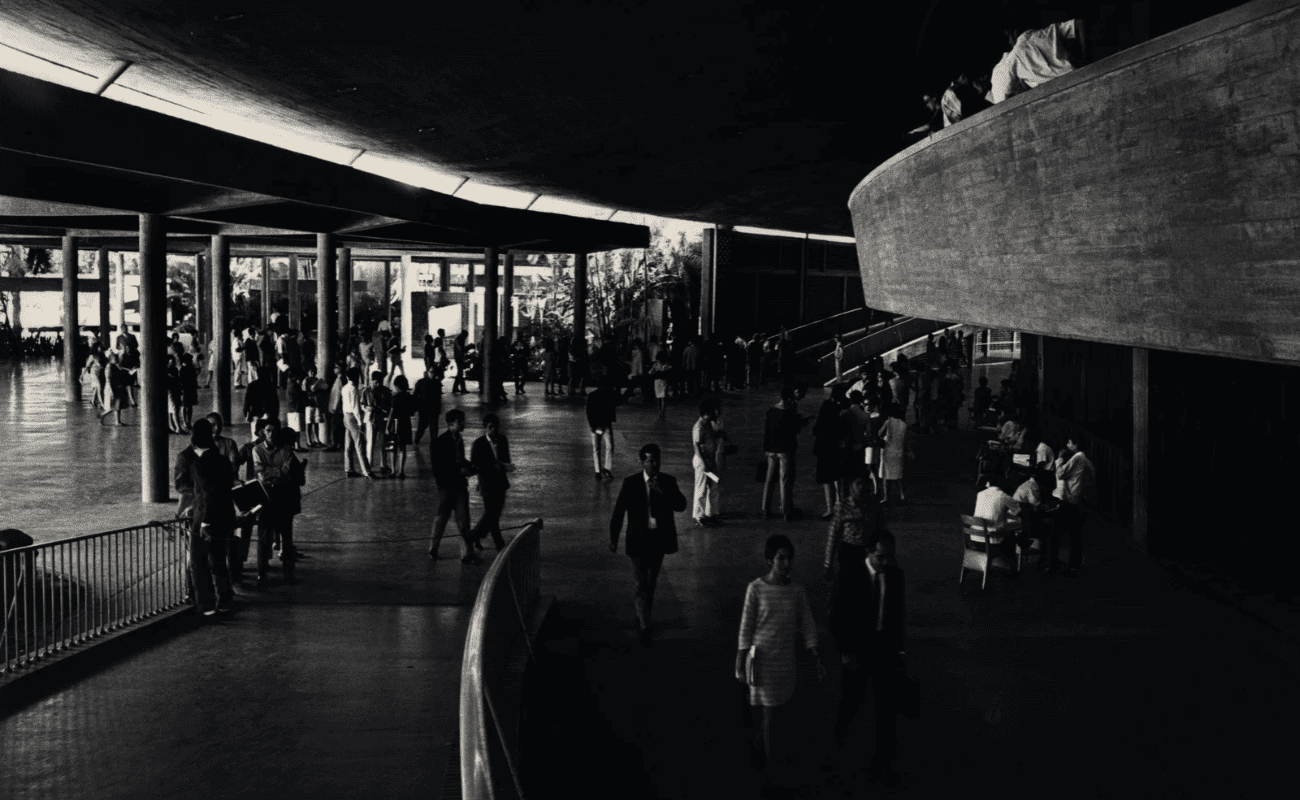
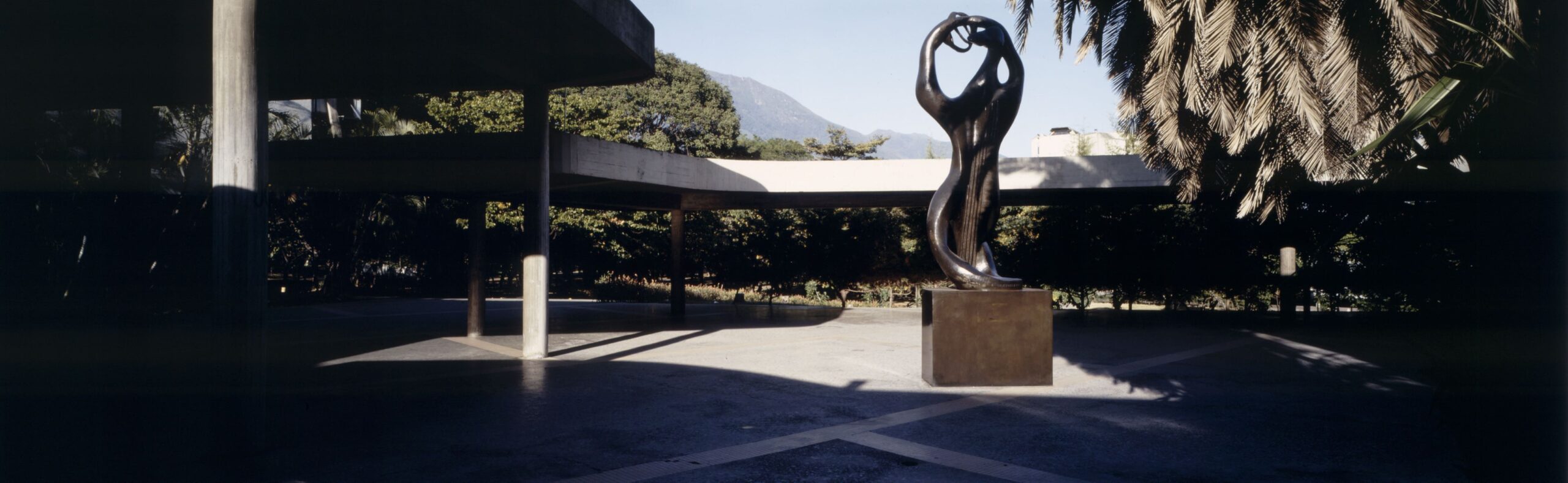
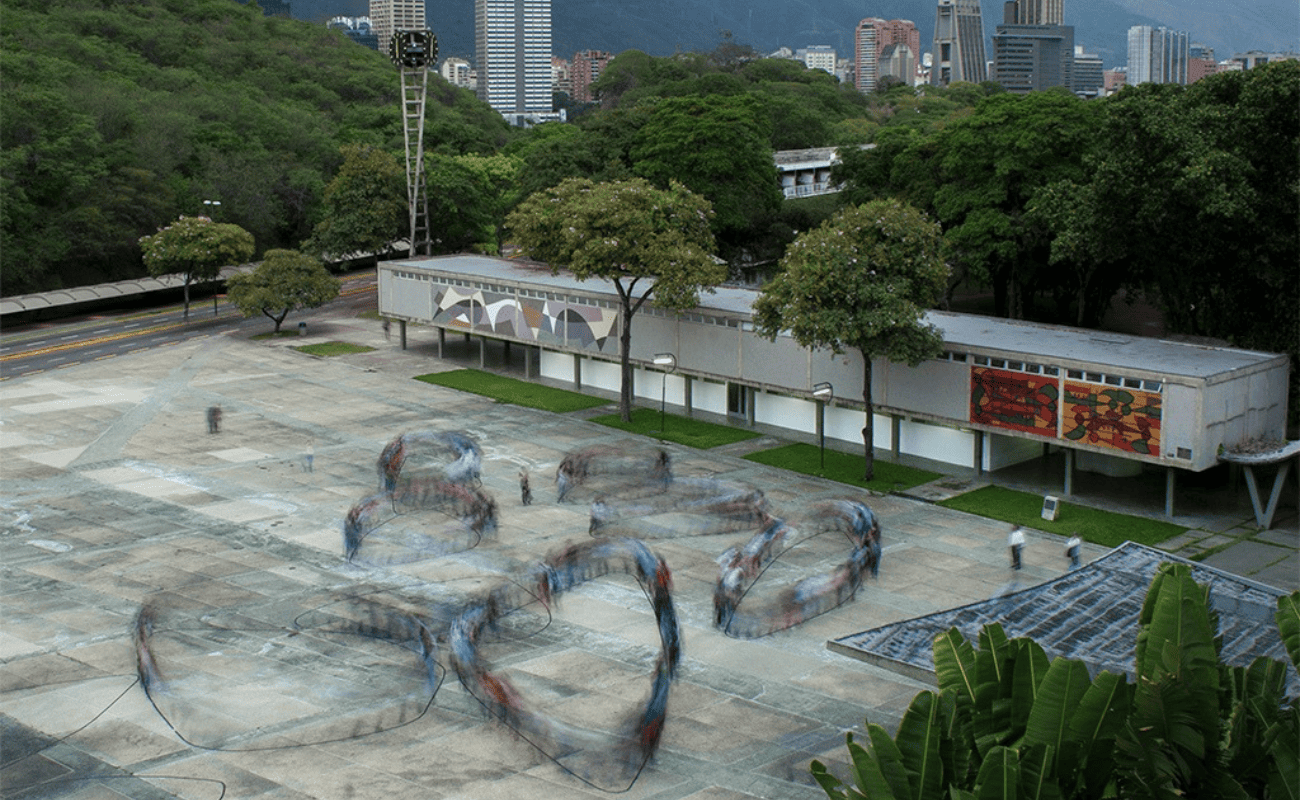
JENNIFER: I think so, especially during music performances or other events that take place in the Aula Magna, but it is important to reiterate that the entire university campus is a living museum filled with site-specific commissions and incredible artworks. There are glass mosaics along the hallways and covering the facades of the buildings. There are also a number of sculptures that were specifically created for the open-air, covered plaza that wraps around the hall. It’s a tremendously beautiful place to experience, much less to study and work within.
LATINNESS: Just out of curiosity, given everything that has happened politically in Venezuela over the years, how have these works been preserved? What was your experience seeing how they are cared for today?
VIC: As far as I understand it, at least, there are incredibly dedicated folks at the university and then at all the museums in Caracas that we saw. They’re just incredibly underfunded, so they’re not getting the support to do everything they would like to do, but they do everything they can with what they have.